

Sea Freight Shipping Guide: From Ningbo Port (Near Yiwu) and Guangzhou Ports to Riyadh Dry Port and Jeddah Islamic Port
Successful shipping from China to Saudi Arabia starts with choosing the right origin port and the right final delivery point—not just comparing the ocean freight rate. If your destination is Riyadh Dry Port, many shipments are routed by sea to King Abdulaziz Port (Dammam) and then moved inland (often by rail/road) to Riyadh. If your destination is the West Coast, Jeddah Islamic Port is the primary gateway on the Red Sea. This guide explains how to choose the best route, estimate timelines and costs, prepare documents, handle customs in Saudi Arabia, and coordinate inland delivery—without confusing the vessel’s arrival with the moment your cargo is actually ready for pickup. (saudiglobalports.com.sa)
How Yiwugocargo helps you ship from China to Saudi Arabia
If your goal is to move cargo “from your supplier’s door in China to your warehouse door in Saudi Arabia” with fewer surprises, having one logistics partner manage the details makes a big difference. At Yiwugocargo, we help Saudi importers ship from China (including sourcing and consolidation around Yiwu) to Riyadh Dry Port or Jeddah Islamic Port through end-to-end, practical services such as:
- Pickup and consolidation from multiple suppliers into one shipment (when needed).
- Carton count + labeling checks and basic pre-shipment verification to reduce documentation mistakes.
- Ocean freight options for FCL (full container) and LCL (shared container), based on your volume and deadline.
- Export documentation coordination in China, aligned with your Incoterms and Saudi import requirements.
- Saudi clearance support and inland delivery planning to Riyadh/Jeddah (based on your agreed scope).
- Clear, status-based updates so you know what is happening and what is needed next.
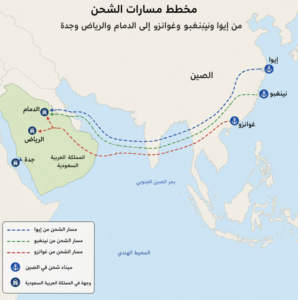
Which route is best from Ningbo or Guangzhou to Riyadh and Jeddah?
The “best” route depends on where your supplier is located, where you want the cargo delivered in Saudi Arabia, and which sailing schedules are available at booking time. If your final point is Riyadh Dry Port, ask for a quote that clearly shows the sea leg to the Eastern Province (typically via Dammam) plus the inland leg to Riyadh. If your final point is Jeddah, ask for a quote that ends at Jeddah Islamic Port and clarifies what happens next (clearance, delivery to your warehouse, and container return rules). The key is to price and plan the full journey, not only the ocean leg. (saudiglobalports.com.sa)
Ningbo for cargo consolidated from Yiwu
Yiwu is strongly connected to the Ningbo–Zhoushan port system through multimodal logistics, making Ningbo Port a common choice when you’re buying from Yiwu (or consolidating from multiple suppliers in Zhejiang). When you request “shipping from Ningbo,” make sure your quote specifies the actual pickup address, the consolidation warehouse (if any), and the export gate-in plan—not just the city name. If you have multiple suppliers, you need a step-by-step collection plan and a verified carton count before confirming the port cut-off. Yiwugocargo can organize pickups, consolidation, and export readiness so you don’t lose days at the port gate. (ezhejiang.gov.cn)
Guangzhou ports: confirm the exact terminal/area
“Guangzhou” often means different terminals/areas in carrier systems (for example, Nansha or Huangpu). So it’s not enough for the supplier to say “ship from Guangzhou.” Always request the exact loading port/terminal details in the quote, then compare the inland trucking cost from your factory to that terminal. For Jeddah-bound cargo, services linking East China and South China to Jeddah are available in the market—however, an announced service does not replace confirming space and schedule at the time of execution. (oocl.com)
Define the shipping scope before you book
Before booking, define exactly what you want your freight partner to be responsible for—from supplier pickup, to export handling, to arrival port handling, to customs clearance, to final delivery. Put it in writing when requesting a quotation, and ask for a clear list of included and excluded charges so you’re not comparing a “full scope” quote with a “partial scope” quote. If you work with Yiwugocargo, ask for a step-by-step cost breakdown so you know where each party’s responsibility begins and ends.
FCL vs LCL: which one fits your shipment?
FCL means you use an entire container for your cargo; LCL means you share a container with other shipments. LCL can be cost-effective for smaller volumes, but it includes extra steps (consolidation, deconsolidation, and additional handling) that can affect the timeline and destination charges. Choose based on your total landed cost and delivery window—not only on volume. (maersk.com)
To receive a quote that is actually usable for planning, share the following:
- Product description (and whether it includes batteries, liquids, or special handling requirements).
- Number of cartons, carton dimensions (after packing), total gross weight, and total CBM.
- Supplier addresses + cargo readiness dates (not only “production ETA”).
- Final delivery city/address in Saudi Arabia and unloading capability (forklift/dock, etc.).
- Agreed Incoterm (EXW/FOB/etc.) and what services you want included in the quote.
How long does it take until your shipment is ready for delivery?
There is no single fixed transit time for shipments from Ningbo or Guangzhou to Saudi Arabia. Ocean sailing time is only one part of the total door-to-door timeline. Your actual delivery timeline depends on the loading and discharge ports, the chosen service, transshipment (if any), documentation readiness, customs processing, and inland transport scheduling. Ask for a timeline broken down by stage—so you can see where delays could occur instead of receiving a vague “your shipment is late.” (maersk.com)
A practical timeline you can track
Use a stage-based checklist with your forwarder (or the Yiwugocargo team) and track expected vs actual dates, the responsible party, and what is required to move to the next stage.
| Stage | What to confirm before you rely on the date |
|---|---|
| China preparation | Cargo packed, carton count verified, markings/labels confirmed |
| Move to port | Pickup booked, port cut-off confirmed, export docs ready |
| Ocean leg | ETD/ETA confirmed, transshipment point (if any) identified |
| Arrival processing | Clearance documents ready; fees/charges process clarified |
| Inland delivery | Rail/truck slot booked; warehouse receiving time confirmed |
If you’re preparing for seasonal demand (Ramadan, promotions, back-to-school), start from your required warehouse date and plan backward. Also, don’t promise customers “delivery” based purely on vessel arrival—carrier schedules can change, and clearance plus delivery needs its own buffer. (myemaersk.maersk.com)
Cost factors and how to compare quotes correctly
Do not choose a provider based only on a low “sea freight” line item. Many base quotes do not include local charges, handling, documentation, or inland delivery. Ask for a written breakdown covering:
- China-side: pickup, consolidation, export handling, documentation.
- Ocean-side: freight rate, surcharges, insurance (if included) and scope.
- Saudi-side: destination handling, clearance support, port/dry port processes, inland delivery.
- Import-related: duties/VAT and any product-specific compliance requirements (after HS code validation).
- Potential extras: storage, inspections, documentation corrections, waiting time, etc.
Also confirm free time rules and how demurrage and detention are calculated. Keeping a container beyond the free period can generate significant charges, and free time can differ by carrier and locati0n. (maersk.com)
Incoterms and responsibility: avoid expensive misunderstandings
Incoterms define who pays which costs, who handles which steps, and when risk transfers—but they do not automatically mean “who pays the freight is responsible for all risk until delivery.” Always write the Incoterm with the named place/port and confirm the version in use. (library.iccwbo.org)
| Incoterm | What it means in practice |
|---|---|
| EXW | Seller makes goods available at their premises; buyer arranges pickup, export, freight, and import |
| FCA | Seller delivers to the carrier at an agreed place and clears export; often practical for containerized freight |
| FOB | Risk transfers when goods are loaded on board at the named port (commonly used for sea, but confirm suitability) |
| CIF | Seller pays freight + minimum insurance to destination port, but risk transfers when loaded on board |
| DAP | Seller delivers to the named place ready for unloading; buyer handles import clearance/duties |
| DDP | Seller delivers with import duties/clearance included; verify feasibility and legal/operational setup |
This is a simplified overview, not a substitute for contract review. ICC guidance highlights that FCA is often appropriate for containers and multimodal moves, while FOB is tied to on-board delivery at the port. Also note that CIF insurance is typically limited—consider whether additional coverage is needed for your cargo value. (library.iccwbo.org)
Shipping documents and Saudi product requirements
Core import documents typically include a commercial invoice, packing list, and bill of lading, and sometimes a certificate of origin depending on the shipment context and proof of origin available. In Saudi Arabia, requirements can also include product compliance or specific approvals depending on the product category. Start by validating the HS code classification and applicable requirements before the cargo leaves China. (zatca.gov.sa)
Build one shared “document pack” with your supplier and your customs broker—don’t wait until after sailing to collect scattered PDFs:
- Commercial invoice: consistent buyer/seller details, product descriptions, quantities, values, and Incoterm.
- Packing list: carton-by-carton totals, weights, dimensions, and clear identifiers.
- Bill of lading: consignee details, ports, delivery place, and release method aligned with your process.
- Origin: confirm if a certificate is required vs other acceptable proof (case-dependent).
- Product compliance: check if the product falls under SABER requirements and whether additional shipment/product certificates are needed.
For products under SABER, review the compliance workflow early. Do not assume a product certificate alone completes the process—shipment-related documentation can also be required. Ask for technical files and compliance documents from your supplier early, and validate requirements before final packing and shipping. (product-safety.saber.sa)
Saudi customs clearance: step by step (high level)
Customs readiness begins before the vessel arrives—not after the container is discharged. Saudi authorities emphasize advance submission of data and documents, and coordination with relevant entities when applicable. In practice, aim to have your documentation complete and reviewed as early as possible to avoid storage and time pressure at arrival. (zatca.gov.sa)
- Before booking: validate product description, HS code, and any restrictions/approvals.
- Before sailing: review draft invoice/packing list; confirm importer/broker details; fix any inconsistencies.
- Before arrival: ensure the broker has all required documents and shipment details for filing.
- During processing: respond quickly to any clarification/inspection requests through your broker.
- After release: coordinate delivery, receiving appointment, unloading, and (if applicable) container return.
Do not treat the broker’s service fee as “everything included.” Separate broker fees from duties/VAT and other third-party charges, and agree on approval rules for any exceptional costs before they occur.
Inland transport to Riyadh Dry Port and to Jeddah (what to plan)
From Dammam (King Abdulaziz Port) to Riyadh Dry Port
There is an operational intermodal link associated with moving containers inland from the Eastern gateways toward Riyadh Dry Port within an integrated sea–rail/road logistics system. Confirm whether your quote includes the inland leg, where customs processes will be completed, and when the cargo becomes “ready for pickup” in Riyadh. Do not assume every Dammam booking automatically includes the Riyadh extension—this must be explicitly planned and priced. (saudiglobalports.com.sa)
After the cargo reaches Riyadh, confirm last-mile delivery to your warehouse, unloading arrangements, and the container return requirements (for FCL moves). Also consider requesting an alternative all-truck option if you prioritize receiving flexibility—then compare both options on total cost and timeline to your door.
Delivery connected to Jeddah Islamic Port
If your cargo arrives into Jeddah Islamic Port, the “inland” leg typically means delivery from the port to your warehouse after clearance and terminal release. Always clarify whether you will receive the full container or whether your cargo will be deconsolidated (LCL) before delivery. If you need transport “to Jeddah port” from within Saudi (for re-export or repositioning), clarify the purpose and the required documentation, because it’s a different service than standard import delivery.
Why customers choose Yiwugocargo for China → Saudi shipping
- Strong coverage for Yiwu-area buying: practical consolidation and export preparation support for multi-supplier orders.
- Clear shipping options: FCL/LCL choices explained with what is included and what is not.
- Fewer documentation issues: pre-sailing checks to reduce clearance delays caused by mismatches.
- End-to-end coordination: planning for Dammam → Riyadh Dry Port or direct arrival to Jeddah based on your final delivery needs.
Pre-shipment checklist (save this before you pay and book)
Before you make the final payment and confirm the booking, align your supplier, freight partner, and broker on one execution plan and confirm these points in writing:
- Exact loading port/terminal, discharge port, and final delivery point (Riyadh Dry Port, Jeddah, or warehouse address).
- Cargo readiness date, cut-off dates, and the full stage-by-stage timeline.
- Full quote breakdown: inclusions, exclusions, currency, validity, and free-time terms.
- Incoterm + named place/port matches your purchase contract and your logistics plan.
- Draft documents reviewed before sailing (invoice, packing list, B/L instructions).
- Clear owner for clearance, delivery booking, unloading, and container return (if applicable).
A “good price” is not the same as a “good plan.” The best result comes from accurate cargo data, comparable quotes, and confirmed responsibilities—then execution with consistent follow-up until delivery.
Request a quote from Yiwugocargo
If you want Yiwugocargo to propose the best route to Riyadh Dry Port or Jeddah Islamic Port based on your cargo type, volume, and delivery city, send us: product type, carton count, weight/CBM, supplier city (and address if available), Incoterm (EXW/FOB/etc.), and your final delivery locati0n in Saudi Arabia. We’ll build a clear shipping plan from China to Saudi Arabia with trackable stages and a practical cost breakdown.
Need the move, not only the article?
Send commodity, ready date and destination. We reply with a routing and a number — usually within one business day.

